independent computational replication
Fibonacci residues modulo prime powers
Status and authorship: I rebuilt this project independently. I wrote and tested the code, reran all 147 finite computations, checked 78 small cases with a separate implementation, compared selected outputs with published benchmarks, and wrote the explanation myself. The benchmark values are published mathematics; I do not claim them as a new discovery.
I counted the residues appearing in Fibonacci, Lucas, and Pell sequences modulo prime powers. The Fibonacci computations match selected benchmark values from Bragman and Rowland's 2025 paper, then apply the same finite experiment to Lucas and Pell cases.
the question
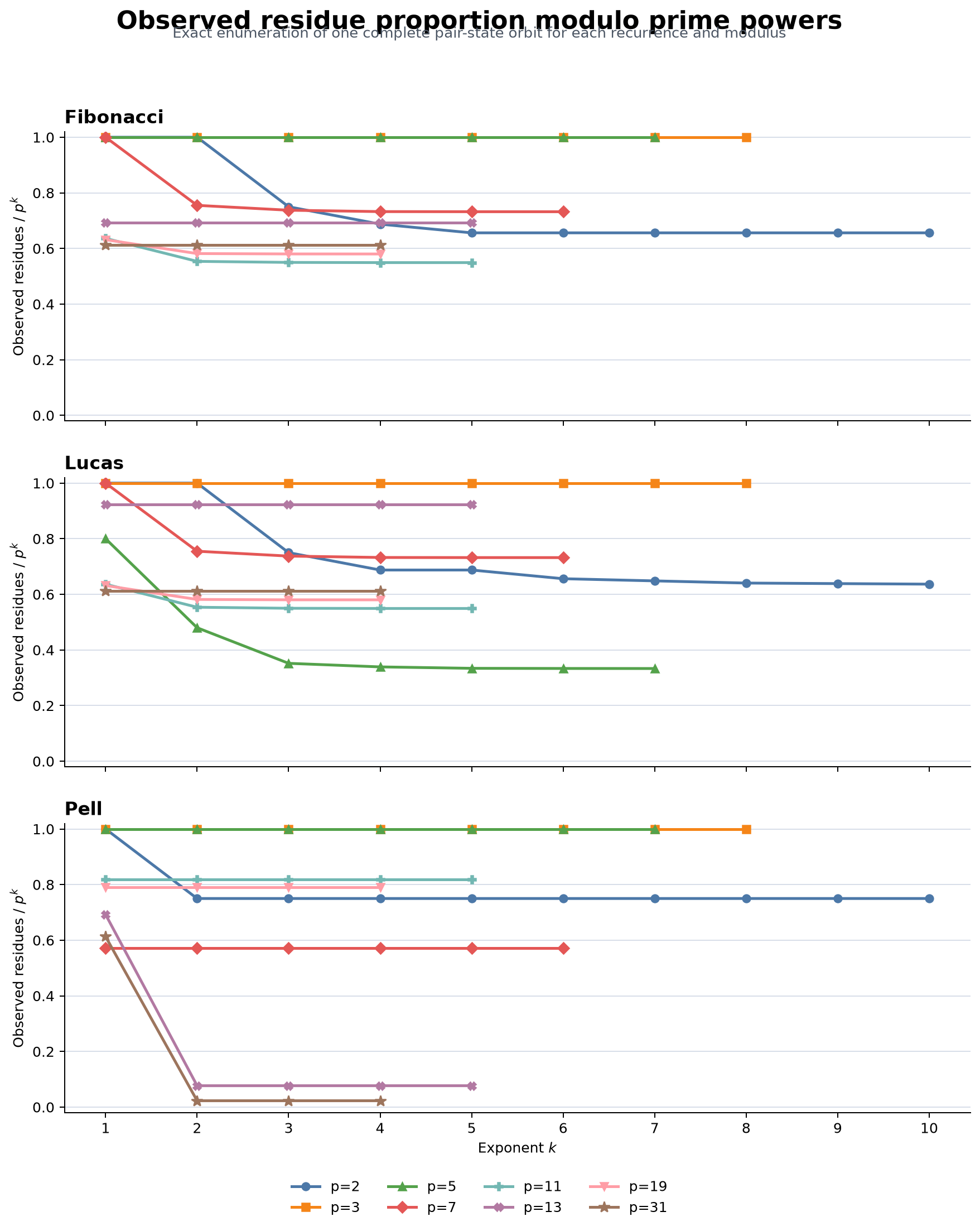
Take a recurrence modulo pk and keep generating terms. Which residues ever appear? Does their proportion change as k grows? I compared Fibonacci and Lucas with Pell, where the coefficient changes from 1 to 2.
My dataset contains 147 runs for eight primes, with exponents limited so a laptop could enumerate the complete orbit.
method
One value can repeat before the whole recurrence cycles. To avoid stopping too early, the code tracks pairs of consecutive values.
x(n + 2) = a x(n + 1) + b x(n) mod m
state(n) = (x(n), x(n + 1))
- Choose m = pk.
- Move to the next pair and record its first coordinate.
- Stop when the original pair comes back.
- Count the different residues and divide that number by pk.
All three recurrences have b = 1, so their pair maps are invertible for each tested modulus. I worked through and checked this pure-cycle behavior before using it.
results
My output agrees with selected published Fibonacci benchmarks. I then ran the same finite experiment for Lucas and Pell sequences.
| Sequence and prime | Tested k | Observed residue proportion |
|---|---|---|
| Fibonacci, p = 13 | 1 to 5 | 9/13 at every tested exponent |
| Lucas, p = 5 | 1 to 7 | 4/5 down to 26,044/78,125, about 0.33336 |
| Lucas, p = 13 | 1 to 5 | 12/13 at every tested exponent |
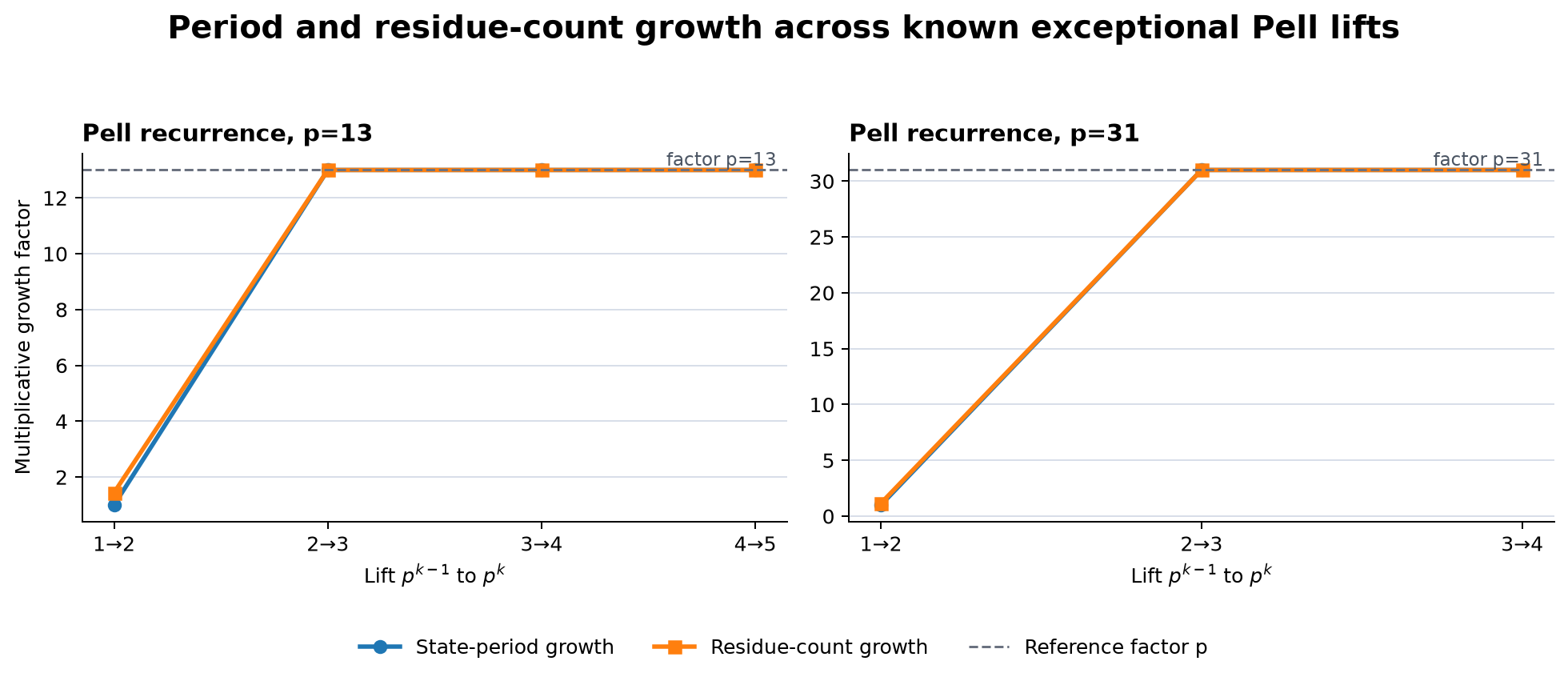
| Pell, p = 13 | 1 to 5 | 9/13 at k = 1, then 1/13 |
| Pell, p = 31 | 1 to 4 | 19/31 at k = 1, then 22/961 |
the observed Pell pattern
At p = 13, the Pell period is 28 for both k = 1 and k = 2, while the residue count only goes from 9 to 13. That drops the proportion from 9/13 to 1/13. In the later saved runs, the period and residue count both multiply by 13, so the proportion stays fixed. At p = 31, my output similarly shows a first-lift drop and later stabilization.
a question from the results
If the Pell state period and residue count both grow by p at one prime-power lift, maybe the residue proportion stays fixed at the later non-exceptional lifts.
These runs motivated the bounded hypothesis. It is not a proof or a claim of a new theorem. A next step would be to test a predeclared wider range and look for counterexamples.
how I checked it
I checked starting-pair returns, confirmed that observed density did not increase under lifting, and completed 78 small-modulus comparisons with a separate implementation. The archive contains five unit tests. These checks support the displayed finite results, but they do not prove the bounded pattern.
- I tested eight primes and only finitely many exponents. That cannot prove a limit.
- Large prime powers take longer because the full state orbit can be long.
- Published work already explains the Fibonacci benchmarks and the unusual Pell periods at 13 and 31.
- My literature search for Lucas and Pell results was targeted, so it cannot be called exhaustive.
- I wrote and tested the code and analysis myself. The files below make every displayed result inspectable and rerunnable.
project files
I included the notebook, code, data, and checks so the project can be inspected and rerun from the saved files.
read and rerun
- executed Jupyter notebook.ipynb The analysis, code cells, tables, and plots.
- complete project.zip The folder structure with code, data, tests, figures, and setup files.
- project guide.md Definitions, rerun commands, outputs, and what I am not claiming.
code
- core Python source.py The recurrence definitions and pair-state counter.
- unit tests.py Checks for known periods, residue counts, and edge cases.
data and checks
- results.csv All 147 runs, one row per sequence, prime, and exponent.
- validation record.json The separate checks and published benchmark comparisons.
sources
main paper
- Bragman and Rowland, Limiting density of the Fibonacci sequence modulo powers of a primeDOI The Fibonacci paper I used as a benchmark.
background reading
- Klaška, Donald Dines Wall's ConjecturePDF Background on the unusual Pell period lifts.
- Avila and Chen, Lucas numbers and complete residue systemsPDF Known results about which Lucas residues appear.
- Bundschuh and Bundschuh, Fibonacci and Lucas numbers modulo powers of 3PDF Published Fibonacci and Lucas results modulo powers of 3.